
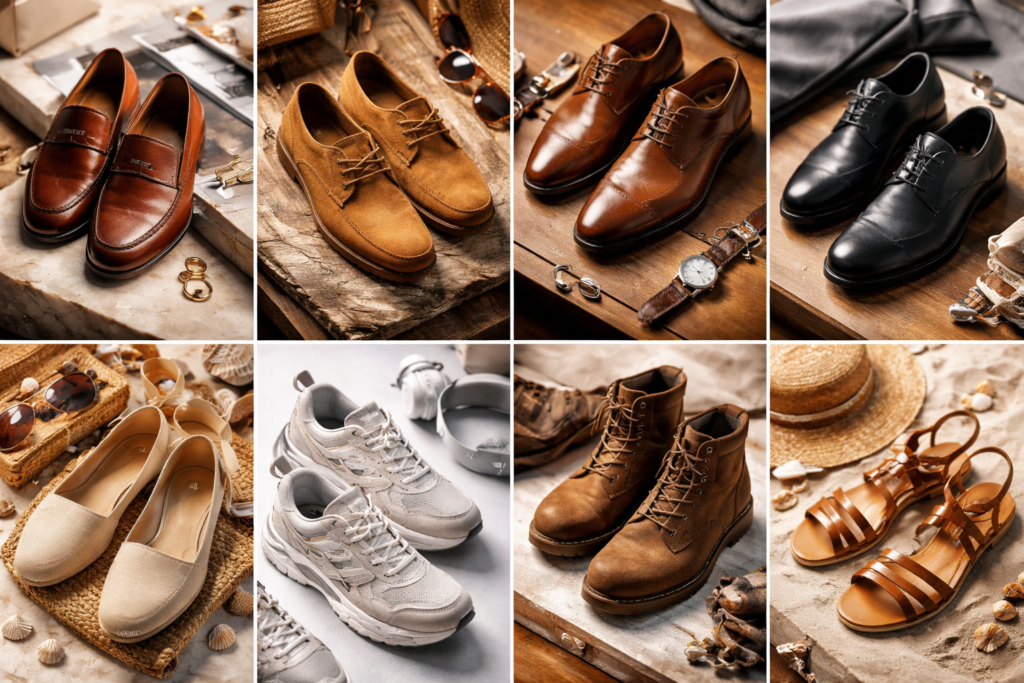
Shoe styles are named according to their historical evolution, purpose of use, and construction methods. Below are the key models that stand out culturally and within the footwear industry.
1. Gova (Décolletée)
“Gova” is a term rooted in Anatolian shoemaking tradition and reflects the craftsmanship of Turkish artisans. The model is typically lightweight, flexible, and side-stitched, making it ideal for everyday wear. Produced with leather or synthetic uppers, gova defines mainly women’s shoe designs.
2. Molyer
With origins in French fashion and classic shoemaking, the molyer is a model in traditional men’s footwear. It features laces, a gently rounded toe, and a clean, understated upper. Molyer shoes are usually crafted with leather or rubber soles and suit both formal and casual settings.
3. Moccasin (Loafer)
Inspired by the soft, single-piece leather shoes made by Native American tribes, the moccasin later evolved into what is now globally known as the loafer. Gaining popularity in Europe in the 20th century, loafers are laceless shoes with flexible uppers and come in a wide range of minimalist to more polished designs.
4. Oxford
Oxfords trace their origins to “Oxonian shoes,” short boots worn by university students in the 1800s. Today, they are known as timeless, sophisticated footwear. Once exclusive to men, Oxfords now include many women’s styles and are typically produced with leather soles in both pointed and rounded toe shapes.
5. Derby
While the Derby was originally used for outdoor activities and hunting in 19th-century England, it became an essential part of everyday urban style by the early 20th century. Distinguished by its open-lacing system, the Derby is a classic men’s shoe, though modern collections offer women’s versions as well. Its structure makes it a comfortable option for high-instep feet.
6. Sneaker
The term “sneaker” comes from the idea of walking quietly or “sneaking,” as early rubber-soled shoes made little noise. Modern sneakers evolved from sports culture and transitioned into everyday fashion. They are produced with lightweight sole materials such as EVA, TPU, and rubber.
7. Espadrille
Originating in the Catalan regions along the Spain–France border, espadrilles feature jute soles and canvas uppers. Their breathable and lightweight structure makes them ideal for summer use.
8. Ballet Flat
Adapted from ballerinas’ footwear, ballet flats gained widespread popularity in the 20th century. These lightweight shoes feature thin construction and flat soles, combining comfort with a simple aesthetic.
9. Boot
One of the oldest footwear forms, boots have been used since prehistoric times to protect the feet and lower legs. They may incorporate rubber, thermo, or PU soles and are made with leather, nubuck, or suede uppers—serving primarily as protective footwear.
10. Sandal
Dating back to ancient Egypt, Rome, and Mesopotamia, sandals are among the earliest known shoe models. Defined by their open-toe and strap design, they exist in a wide range of casual and elegant variations.